Stacy Millicent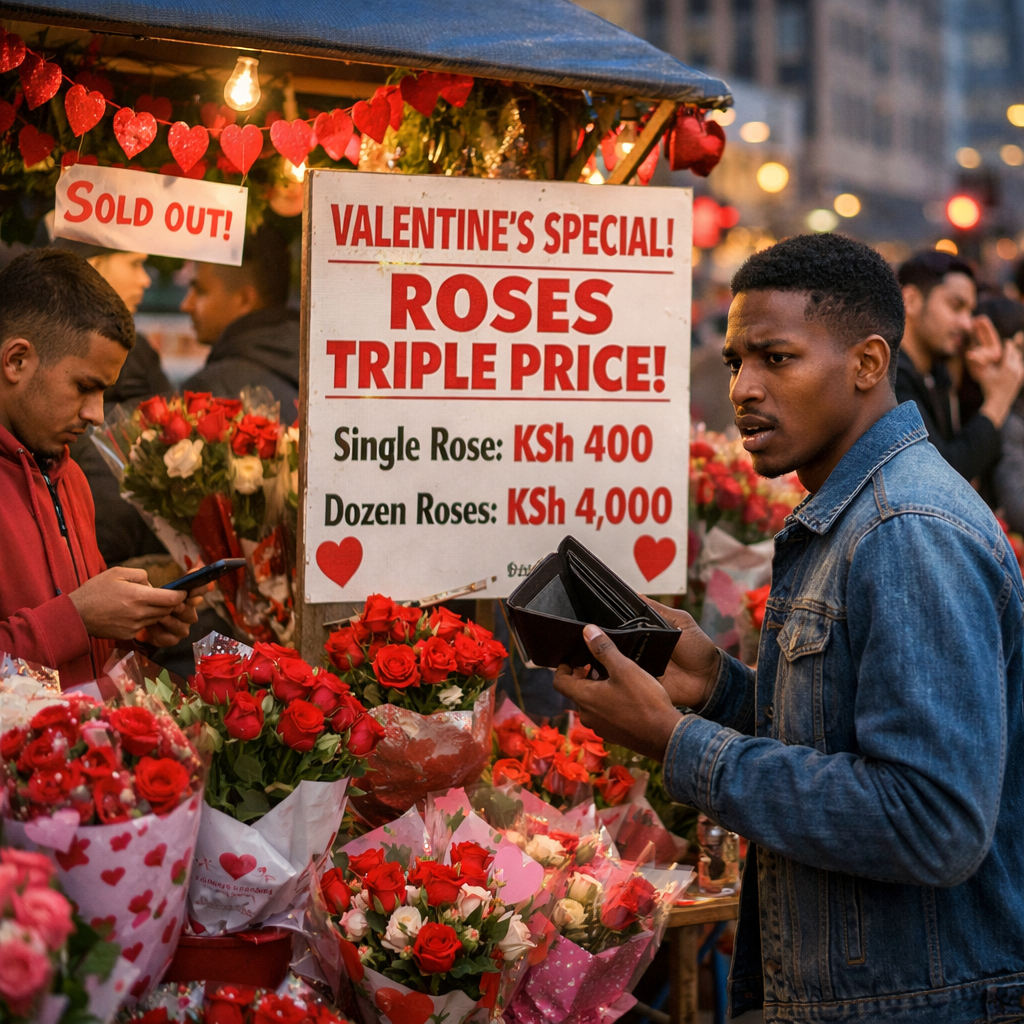
On any other day, a single red rose is just a flower. But on Valentine’s Day, it becomes a declaration. A promise. A silent “I love you.”
This year, however, love came at a cost many did not expect.
Across towns and cities, flower prices have tripled, leaving lovers stranded, embarrassed, and in some cases, creatively desperate.
Just a week ago, a bouquet that cost KSh 1,500 now goes for KSh 4,000. A single red rose that was KSh 150 is selling for KSh 400. Florists say demand has exploded. Lovers say they have been ambushed.
At one busy roadside stall, young men stood staring at price tags longer than they usually stare at their girlfriends. One whispered into his phone, “Babe, can we celebrate tomorrow instead?” Another quietly asked the vendor if she had ‘anything small… like one flower broken into two?’
For many, Valentine’s Day is not just about flowers. It’s about proving effort. And in the age of social media, proof is photographed, filtered, and posted.
“I planned everything,” said Brian, 24, who had budgeted KSh 2,000 for flowers and chocolate. “But when I reached the shop, I thought I had misread the prices. I almost thought it was a joke.”
Florists defend the hike. They blame increased supplier costs, transportation fees, and high demand. Some say farms raise prices weeks before February 14. Others quietly admit it’s simply business.
“Valentine’s comes once a year,” one seller said with a shrug. “We must also survive.”
But customers feel squeezed.
Mary, a university student, said she watched her boyfriend walk into a flower shop confidently and walk out looking defeated. “He pretended he didn’t want flowers,” she laughed. “But I know it’s the price.”
Economists call it seasonal demand. Social media calls it heartbreak.
In past years, long queues formed outside flower stalls. This year, some lovers are turning to alternatives — handwritten letters, simple dinners, even artificial flowers. Others are choosing humor over pressure.
One viral post read: “At these prices, I will send you a screenshot of roses. Please imagine the fragrance.”
Yet behind the jokes lies a deeper question: Has Valentine’s Day become too commercial?
Relationship experts argue that the pressure to buy expensive gifts often overshadows the meaning of the day. When the cost of affection becomes a financial burden, the romance slowly fades into anxiety.
Still, by mid-afternoon, most flower stalls were nearly sold out.
Because despite the prices, many lovers still bought them.
Some dipped into savings. Some reduced their dinner plans. Some bought a single rose instead of twelve. But they bought.
Why?
Because Valentine’s Day, for better or worse, is emotional. And emotion rarely waits for economic stability.
As evening approached, a man in a worn-out jacket carefully selected one rose. He counted his coins twice before paying. When asked why he didn’t choose something cheaper, he simply smiled.
“She loves flowers,” he said.
In the end, maybe that’s the story.
Not of prices tripling. Not of inflation. Not of business.
But of how love, even when expensive, still finds a way.
And tomorrow, when the price of roses drops again, life will return to normal.
Until next February.